
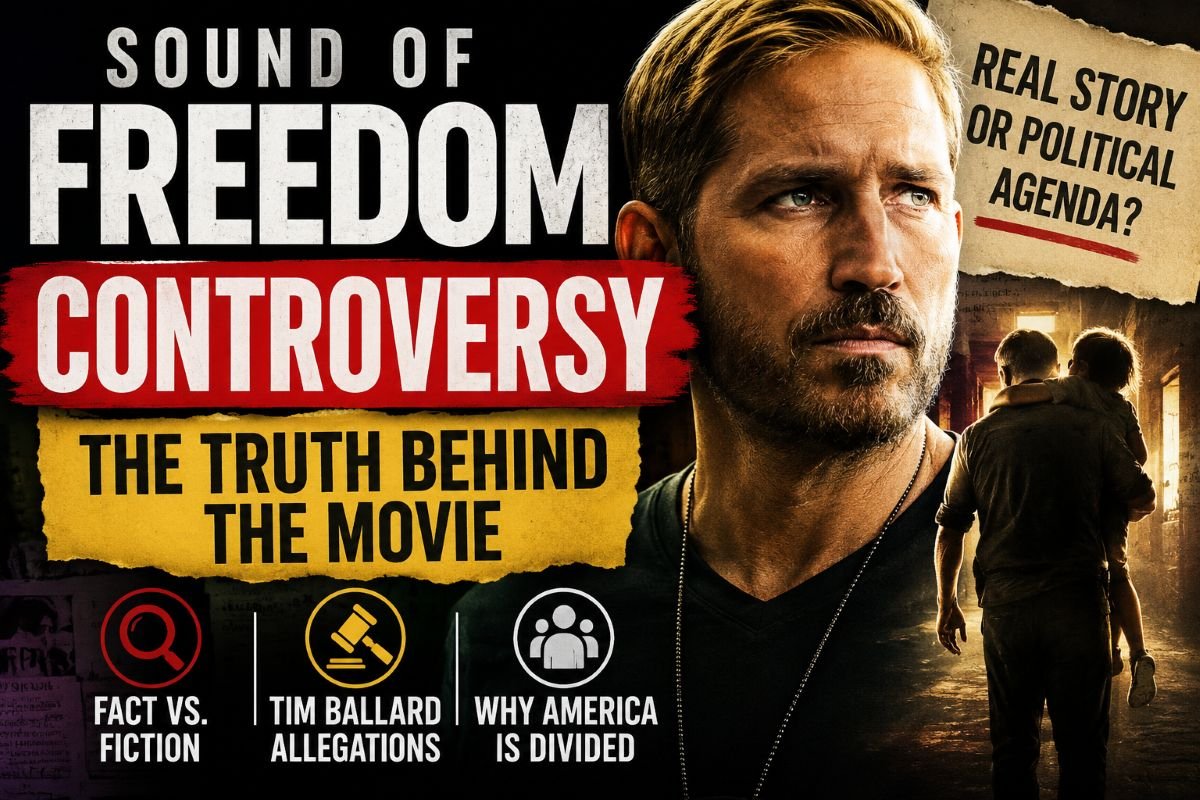
The Sound of Freedom controversy has become one of the most discussed stories at the intersection of Hollywood, politics, and anti trafficking advocacy. What began as an independent film inspired by the work of former Homeland Security agent Tim Ballard evolved into a nationwide cultural debate that extends far beyond the movie itself. Since its release in 2023, the film has generated passionate support, sharp criticism, record breaking box office success for an independent distributor, and continued scrutiny over the real people and organizations connected to its story.
For many Americans, Sound of Freedom brought renewed attention to the global problem of child trafficking. For others, it raised important questions about historical accuracy, the portrayal of trafficking, and whether audiences were presented with a balanced picture of the issue. More recently, legal disputes involving Ballard and renewed discussion about Operation Underground Railroad have kept the film in the headlines, ensuring the Sound of Freedom controversy remains relevant well after its theatrical run.
What is the Sound of Freedom controversy?
The Sound of Freedom controversy is not rooted in a single event. Instead, it reflects several overlapping debates involving the film’s accuracy, its political reception, the public image of Tim Ballard, and broader conversations about how child trafficking should be portrayed in popular media.
Released by Angel Studios on July 4, 2023, Sound of Freedom stars Jim Caviezel as Ballard, a former Department of Homeland Security special agent who founded Operation Underground Railroad, commonly known as O.U.R. The film follows Ballard’s mission to rescue children from traffickers in Colombia and is promoted as being inspired by true events.
Although the movie is based on Ballard’s work, filmmakers have acknowledged that several scenes were dramatized or condensed for storytelling purposes. Critics argue that some viewers interpreted the film as a literal account of historical events, while supporters viewed it as a dramatic retelling designed to raise awareness rather than a documentary.
That distinction lies at the center of the Sound of Freedom controversy. The debate is less about whether child trafficking exists, a fact universally recognized by law enforcement and advocacy groups, and more about how accurately the film represents the crime and the methods used to combat it.
Why the film sparked public debate
Few independent movies have experienced the kind of commercial success achieved by Sound of Freedom. Produced on a modest budget, the film became one of the biggest box office surprises of 2023, earning more than $250 million worldwide through strong word of mouth, faith based audiences, and Angel Studios’ innovative “Pay It Forward” ticket campaign.
Its financial success quickly transformed the film into more than just an entertainment release. Political commentators, religious leaders, celebrities, and social media influencers embraced the movie, often framing it as an overlooked story finally reaching mainstream audiences.
At the same time, critics argued that public discussion surrounding the film increasingly blended legitimate concerns about child trafficking with politically charged narratives. As a result, the Sound of Freedom controversy expanded beyond reviews of the movie and became part of broader debates about media trust, misinformation, and cultural polarization in the United States.
The film also generated viral online claims ranging from allegations that theaters were suppressing screenings to accusations that critics were attempting to silence discussion about trafficking. Many of those social media claims were later challenged or debunked by journalists and independent fact checkers, adding another layer to the controversy.
Criticism from media, experts, and advocacy groups
A major part of the Sound of Freedom controversy involves criticism from journalists, researchers, and organizations that work directly with trafficking survivors.
Many anti trafficking experts argue that the movie emphasizes dramatic rescue operations while giving comparatively little attention to the more common realities of trafficking. According to specialists interviewed by outlets including Time, NPR, and the BBC, many trafficking victims are exploited by people they already know, including family members, intimate partners, employers, or trusted adults, rather than by strangers operating international kidnapping rings.
Experts also caution that large scale rescue missions, while compelling on screen, represent only a small part of anti trafficking work. Long term survivor support, criminal investigations, prevention programs, and partnerships with local law enforcement are often considered more effective tools in combating trafficking than the cinematic operations portrayed in the film.
Another source of debate involves the movie’s perceived association with conspiracy theories. Some commentators have pointed to public remarks made by Jim Caviezel and Tim Ballard outside the film, including references to unsupported claims that have circulated within QAnon related communities. Critics argue those comments contributed to public confusion, even though the film itself does not reference QAnon or promote its central narratives.
Supporters, however, maintain that those external controversies should not define the movie. They argue the film should be judged on its own message of raising awareness about child exploitation rather than on statements made by individuals during interviews or public appearances.
Supporters’ arguments and responses
While critics questioned parts of the film, supporters argue that the Sound of Freedom controversy has often overshadowed the movie’s central purpose. They contend that Sound of Freedom succeeded because it encouraged millions of Americans to discuss child trafficking, an issue that rarely receives sustained attention in mainstream entertainment.
Angel Studios has consistently rejected claims that the film promotes conspiracy theories. Company executives have emphasized that Sound of Freedom is a dramatized feature inspired by real events rather than a documentary or political statement. The studio has also said its goal was to increase public awareness of child exploitation and inspire viewers to learn more about the issue.
Many supporters believe critics focused too heavily on political interpretations instead of the broader humanitarian message. They argue that even if certain scenes were fictionalized for dramatic effect, the movie succeeded in encouraging conversations about child trafficking and support for organizations working to protect vulnerable children.
Audience reaction reflected that support. Despite mixed critical reviews, Sound of Freedom earned an A plus CinemaScore and maintained strong audience ratings across several major review platforms. That gap between professional critics and moviegoers became another defining feature of the Sound of Freedom controversy.
The role of Tim Ballard and Operation Underground Railroad
The Sound of Freedom controversy cannot be fully understood without examining Tim Ballard and Operation Underground Railroad, the nonprofit organization he founded in 2013 after leaving the Department of Homeland Security.
For years, Ballard became one of the country’s best known anti trafficking advocates, promoting rescue missions conducted alongside law enforcement agencies in several countries. His work inspired the film’s central storyline and helped shape its marketing.
However, Ballard’s public reputation changed significantly after the movie’s release.
In 2023, Operation Underground Railroad announced that Ballard had separated from the organization following an internal investigation into workplace conduct allegations. Multiple civil lawsuits later accused Ballard of sexual misconduct during anti trafficking missions. Ballard has denied the allegations, calling them false and politically motivated.
In late 2025, prosecutors in Salt Lake County announced they would not file criminal charges against Ballard, citing insufficient admissible evidence to pursue prosecution. That decision did not resolve the pending civil litigation, which remains separate from any criminal investigation.
These developments became an important part of the Sound of Freedom controversy because they shifted public discussion from the film itself to the real individual whose story inspired it. Supporters note that Ballard has not been criminally charged in connection with those allegations, while critics argue the lawsuits and investigative reporting deserve continued public scrutiny.
Box office success despite controversy
Regardless of where audiences stood on the debate, Sound of Freedom became one of the most remarkable box office success stories in recent years.
Produced for approximately $14.5 million, the film earned more than $250 million worldwide, making it one of the highest grossing independent releases of 2023. Its domestic earnings exceeded many studio backed productions with far larger marketing budgets.
Angel Studios credited much of that success to its community driven marketing strategy, particularly the “Pay It Forward” program that allowed supporters to purchase tickets for others. The campaign created strong word of mouth and helped expand the film’s reach beyond traditional faith based audiences.
Industry analysts also viewed the movie as evidence that independent distributors could compete with major Hollywood studios by cultivating highly engaged audiences. Even those who criticized the film acknowledged that its commercial performance was extraordinary.
How the controversy influenced public perception
The Sound of Freedom controversy has influenced public understanding in ways that extend well beyond the movie industry.
For many viewers, the film served as an introduction to child trafficking and encouraged further research into the issue. Online searches related to trafficking, Tim Ballard, Operation Underground Railroad, and anti trafficking organizations increased following the movie’s release.
At the same time, experts warned that audiences should distinguish between cinematic storytelling and documented investigative practices. Advocacy groups have emphasized that trafficking cases often involve coercion, manipulation, family members, intimate partners, or trusted individuals rather than dramatic rescue operations portrayed in action films.
The controversy has also become a broader discussion about how movies based on true stories should balance entertainment with historical accuracy. Many Americans now expect greater transparency when filmmakers adapt real events, particularly when those stories involve ongoing legal or political debates.
Latest verified developments related to the controversy
As of 2026, the Sound of Freedom controversy continues to evolve through ongoing reporting rather than new developments involving the film itself.
Tim Ballard remains involved in multiple civil legal disputes and continues to deny allegations made against him. Meanwhile, Operation Underground Railroad has moved forward under new leadership, distancing itself from its founder while continuing its stated mission to combat child trafficking.
Angel Studios has faced no legal action related to the content of Sound of Freedom, and the movie remains widely available through streaming and home media platforms. The film continues to attract new audiences, ensuring that debates over its historical accuracy, political reception, and cultural impact remain active.
Today, the Sound of Freedom controversy represents more than disagreement over a successful independent movie. It has become a continuing national conversation about factual storytelling, public trust, anti trafficking advocacy, media responsibility, and how Americans evaluate films inspired by real events. That combination of entertainment, public policy, and ongoing legal developments explains why interest in the subject continues years after the movie first reached theaters.
Read More: Wait Wait Don’t Tell Me Returns With Fresh Energy as NPR’s Beloved News Quiz Enters a New Chapter
