


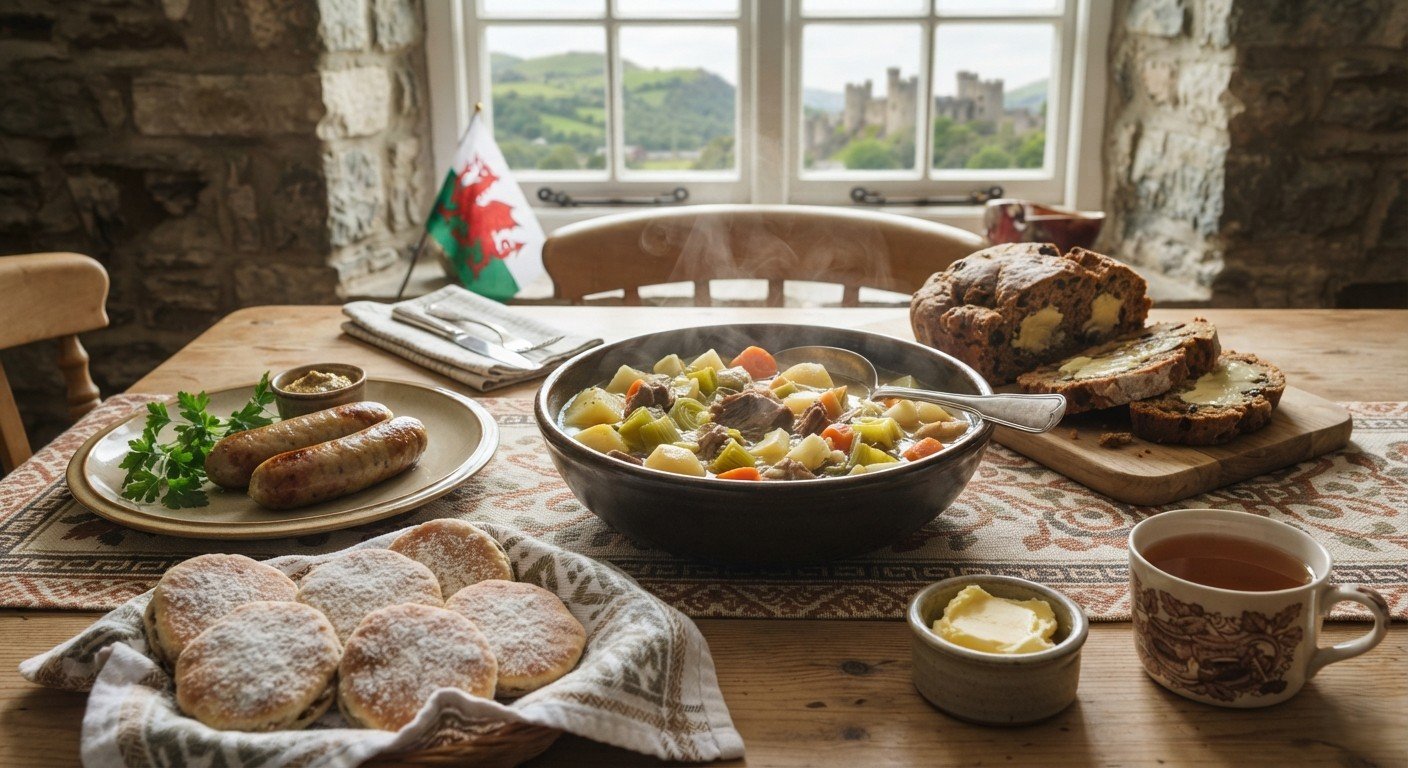
If you have ever stood at Manchester Piccadilly waiting for the train to Llandudno, you have probably wondered what awaits beyond the border. Welsh food deserves far more attention than it gets. For too long, it has lived in the shadow of English and Scottish cuisine. That is changing. More Mancunians than ever are heading west for weekend breaks, drawn by the promise of rugged coastlines, proper pubs, and plates of food that tell a story.
Welsh food is not English food with a dragon on the label. It carries its own history, shaped by Celtic roots, centuries of farming on steep hillsides, and a coastline that has fed generations. The dishes are simple, hearty, and resourceful. They were built for miners, farmers, and fishermen who needed sustenance, not spectacle. For anyone travelling from Manchester, this is part of the appeal. You will find meals that feel honest, rooted in place, and genuinely different from what you get at home.
Here is everything you need to know about Welsh food before your next trip.
What Is Welsh Food?
Welsh food is the product of geography and necessity. Wales is a country of mountains, narrow valleys, and a long, often wild coastline. Much of the land is unsuited to large-scale arable farming. Instead, generations of Welsh farmers have raised sheep and cattle on hillside pastures. The result is a cuisine built around lamb, beef, dairy, leeks, and whatever the sea provides.
Celtic influence runs deep. Many traditional Welsh dishes predate modern borders. Cawl, the national stew, has roots stretching back to the 14th century. Baking traditions such as bara brith and Welsh cakes reflect a culture where the hearth was the heart of the home. Coastal communities developed their own foodways around seaweed, cockles, and mussels, ingredients that cost nothing but effort.
Seasonal cooking matters in Wales. Spring brings tender lamb. Summer offers cockles from the Gower. Autumn delivers plums from the Vale of Clwyd. Winter demands the deep warmth of cawl and rarebit. This is not a cuisine of air miles and year-round imports. It is local, practical, and proud of it.
Why Welsh Food Is Unique
The geography of Wales sets its food apart from anything you will find in England. Three sheep roam the hills for every person in the country. The lamb that results is unlike English lamb. It carries the flavour of heather, grass, and clean mountain air. Welsh lamb holds Protected Geographical Indication status, awarded by the European Commission in 2003 and retained under UK law after Brexit. Only lamb born and reared in Wales, fully traceable and processed in approved abattoirs, can carry the name. This puts it in the same bracket as Parma ham.
The coastline is equally distinctive. The Menai Strait produces almost half of the UK’s mussels. The Gower Peninsula yields cockles harvested by hand at low tide. Laver seaweed, stewed into laverbread, has been gathered along the South Wales coast for centuries. These are not tourist novelties. They are working ingredients, still eaten daily in Welsh kitchens.
Cheese making in Wales has seen a remarkable revival. Caerphilly, the country’s best-known cheese, nearly disappeared from Welsh production during the 20th century as English factories took over. Today, artisan makers in South and North Wales are reclaiming the tradition. Snowdonia Cheese Company’s Black Bomber, Caws Cenarth’s Perl Wen, and Teifi Organic Halloumi are winning awards and finding their way onto menus well beyond Cardiff.
Baking, too, holds a special place. The Welsh bakestone, a flat iron or steel plate heated over a fire, has produced generations of Welsh cakes, bara brith, and oatcakes. These are not fancy patisserie items. They are everyday treats, made at home and sold in village shops, and they taste better for it.
Traditional Welsh Food Everyone Should Try
Cawl
Cawl is the dish that best explains Welsh food. It is a slow-cooked stew of lamb, leeks, swedes, carrots, and seasonal vegetables, traditionally thickened with potatoes. The name comes from the Welsh word for soup, though cawl is closer to a broth-heavy stew. In parts of North Wales, locals still call it lobscows, a name with Norse roots that hints at the dish’s ancient origins.
Cawl was once the staple meal of Welsh farmworkers and miners. It was cooked in a single pot over an open fire, with ingredients added according to what was available. The meat, usually neck or breast of lamb, was simmered for hours until it fell apart. Vegetables went in later. Bread and cheese were served on the side.
The taste is deep, savoury, and comforting. The lamb gives richness. The leeks add sweetness. The swede brings an earthy note. It is the kind of meal that makes sense after a damp walk up Snowdon.
You will find cawl on pub menus across Wales, but it varies by region. In Pembrokeshire, some cooks add sewin, the local sea trout. In Conwy, mussels sometimes make an appearance. For Manchester visitors, cawl is the perfect introduction. It costs little, fills you up, and tells you exactly where you are.
Welsh Rarebit
Welsh rarebit is the dish that stops every first-time visitor. It looks like cheese on toast. It is not cheese on toast. The origins are medieval. Hard cheese was melted by the fire and spread onto bread. Over time, the recipe grew more elaborate. Today, a proper Welsh rarebit starts with a roux of butter and flour. Mature Welsh cheddar is melted in, along with mustard, Worcestershire sauce, and sometimes Welsh ale. The mixture is spread thickly onto bread and grilled until blistered and golden.
The result is richer, sharper, and altogether more satisfying than anything you can achieve with a slice of processed cheese under the grill. The mustard cuts through the fat. The ale adds depth. The Worcestershire sauce brings a savoury tang that ordinary cheese on toast simply cannot match.
Some pubs serve it with a poached egg on top. Others add laverbread for a coastal twist. It works as a light lunch, a late-night snack, or a hangover cure after one too many pints of Brains. For anyone travelling from Manchester, it is an easy win. You will find it everywhere from Cardiff market stalls to country inns in the Brecon Beacons.
Welsh Cakes
Welsh cakes are small, round, and deceptively simple. They are made from flour, butter or lard, sugar, dried fruit, and mixed spice, bound with egg or milk and cooked on a bakestone or heavy griddle. The outside is lightly crisp. The inside is soft, slightly crumbly, and sweet without being cloying.
They were originally a miner’s food. The cakes travelled well in a pocket or tin, providing a quick hit of energy underground. Today, they are sold in every bakery and tea room in Wales. Some makers add chocolate chips. Others experiment with lemon or orange zest. The traditional version, dusted with caster sugar while still warm, remains the best.
For Manchester visitors, Welsh cakes are the ideal souvenir. They keep for several days, travel well, and cost next to nothing. Popty Tandderwen Bakery in Betws-y-Coed makes an excellent batch. The Welsh Cake Hut in Cwmbran is worth a detour if you are heading south.
Bara Brith
Bara brith translates as speckled bread, and that is exactly what it is. The authentic version is a yeasted tea loaf, rich with dried fruit that has been soaked overnight in strong tea. Mixed spice, and sometimes caraway, gives it a warm, aromatic flavour. The texture is dense and moist, closer to a fruit bread than a cake.
Supermarket versions often resemble fruit cake, but the real thing is different. It should be sliced thickly, spread with salted butter, and eaten with a pot of tea. Some Welsh cheese boards include bara brith as a sweet counterpoint to mature cheddar. Snowdonia Cheese Company’s Black Bomber pairs particularly well with it.
Bara brith dates back to the 19th century, though similar fruit breads existed in Wales long before. It remains a staple of Welsh tea rooms and bakery counters. For Manchester visitors, it is an easy taste of tradition. Buy a loaf on Saturday morning and it will see you through the weekend.
Glamorgan Sausage
Glamorgan sausages contain no meat at all. They are vegetarian croquettes made from cheese, leeks, breadcrumbs, and herbs, shaped into cylinders and fried until golden. The original recipe used Glamorgan cheese, made from the milk of Glamorgan cattle. The breed dwindled to near extinction, and today most makers use Caerphilly or mature cheddar instead.
The dish rose to prominence during the Second World War when meat was rationed. Welsh cooks proved that cheese and leeks, two ingredients they had in abundance, could produce something just as satisfying as a pork sausage. The leeks provide sweetness and texture. The cheese melts into a creamy centre. The breadcrumb coating gives crunch.
Glamorgan sausages have crossed the border. You can find them in English supermarkets now. But they taste better in Wales, where the cheese is fresher and the leeks are local. The Red Fox Inn in the Vale of Glamorgan does a particularly good version. For vegetarian travellers from Manchester, this is a must-try.
Laverbread
Laverbread is Wales’s most divisive food. It is made from laver seaweed, harvested from the rocks along the South Wales coast, then boiled for hours until it becomes a dark, glossy paste. The taste is intensely salty and mineral, unmistakably of the sea. Richard Burton famously called it Welshman’s caviar.
Nutritionally, laverbread is remarkable. It is rich in vitamin B12, iron, and iodine. Welsh coastal communities have eaten it for centuries, usually at breakfast. The traditional serving is a small cake of laverbread mixed with oatmeal, fried in bacon fat, and served alongside eggs, bacon, and cockles.
It is not for everyone. The texture puts some people off. The flavour is strong. But it is worth trying at least once, if only to understand how deeply Welsh food is tied to the coastline. Café Môr in Pembrokeshire serves it in a breakfast roll with bacon, egg, and Welsh cheddar. For adventurous Manchester visitors, it is a story to take home.
Welsh Lamb
Welsh lamb is the ingredient that defines Welsh cuisine. With PGI status since 2003, it is one of the most protected food products in Britain. The sheep are born and reared in Wales, grazing on grass, heather, and hillside forage. The meat is lean, tender, and carries a sweetness that lowland lamb cannot match.
Cooking styles vary by region. In Snowdonia, slow-roasted shoulder with rosemary and garlic is common. In Pembrokeshire, salt marsh lamb, grazed on coastal wetlands, has a subtly different flavour, slightly briny and herbaceous. Cawl, of course, remains the most traditional preparation.
For Manchester visitors, Welsh lamb is the meal to plan a trip around. It is served in pubs, restaurants, and farm shops across the country. The Rhug Estate in Corwen sells premium Welsh lamb from its own farm, along with bison and venison. If you are driving from Manchester, it makes a perfect stop on the A5.
Cockles
Cockles have been part of Welsh coastal life for generations. They are small, heart-shaped shellfish with a delicate, salty flesh. In South Wales, they were once harvested from the sands of the Gower and carried to Swansea market by donkey. The donkeys are gone, but the cockles remain.
They are best eaten simply. Steamed cockles, served in a small pot with a dash of vinegar, are a classic Welsh snack. They also appear in full Welsh breakfasts, paired with laverbread and bacon. Penclawdd on the Burry Estuary is still a centre of production. Cardiff Market, over a century old, has stalls selling them fresh.
For Manchester visitors, cockles are an affordable taste of the coast. They cost a few pounds. They take seconds to eat. And they connect you to a food tradition that has barely changed in two hundred years.
Welsh Cheese
Wales produces some of the most interesting cheeses in Britain, yet it remains underrated outside the country. Caerphilly is the flagship. The original 19th-century version was moist, creamy, and slightly tangy. Mass-produced English Caerphilly is dry and crumbly by comparison. Welsh artisan makers are reviving the old style.
Perl Wen, from Caws Cenarth in West Wales, is a soft cheese that sits somewhere between Brie and Caerphilly. It has a fresh, citrus flavour and a creamy centre. Perl Las, its blue sibling, is golden, creamy, and gently salty. Y Fenni, also known as Red Dragon, is a firm cheddar made with Welsh ale and mustard seeds. Tintern, from the same region, is blended with chives and shallots.
For Manchester visitors, Welsh cheese is the ideal edible souvenir. It travels well, keeps for days, and offers something genuinely different from the usual supermarket selection. Farm shops in Conwy, Llandudno, and Betws-y-Coed stock excellent local varieties.
Traditional Welsh Desserts
Welsh desserts tend towards the simple and sustaining. Teisen lap is a large, moist cake baked on a plate. It was designed for miners. The dense texture meant it did not crumble in a lunchbox. Today, it is still found in Welsh bakeries, usually flavoured with dried fruit and spice.
Crempogau are thick, fluffy pancakes, closer to Scotch pancakes than French crepes. They are traditionally eaten on Shrove Tuesday, stacked high and drizzled with butter and honey. Aberffraw biscuits, from Anglesey, are buttery shortbreads shaped like scallop shells. They date back to the 13th century and may be among the oldest biscuits in Britain.
For Manchester visitors with a sweet tooth, these are the treats to seek out in village cafes and tea rooms. They pair perfectly with a strong Welsh brew after a morning on the hills.
Best Places to Try Welsh Food
Cardiff
Cardiff is the obvious starting point. The capital has everything from traditional market stalls to modern Welsh restaurants. Cardiff Market, open since 1891, sells cockles, laverbread, and Welsh cakes from family-run stalls. The city also hosts some of the most ambitious Welsh cooking in the country, with chefs reinterpreting traditional dishes for contemporary palates.
Swansea
Swansea sits at the heart of South Wales cockle country. The market still sells Penclawdd cockles by the bag. The seafront pubs serve them simply, with vinegar and brown bread. Swansea is also a good base for exploring Gower Peninsula produce, from salt marsh lamb to laverbread.
Conwy
Conwy is a walled market town on the North Wales coast. It is famous for Conwy mussels, harvested from the estuary and served in local pubs and restaurants. The town’s food scene is compact but genuine. You will find cawl, rarebit, and local cheeses within the city walls.
Llandudno
Llandudno is where many Manchester visitors arrive, either by train or car. The Victorian resort has a surprisingly good food offering. Local cafes serve Welsh breakfasts with laverbread and cockles. Bakeries sell fresh bara brith and Welsh cakes. The town is also a gateway to the Conwy Valley, where farm shops stock local lamb and cheese.
Betws-y-Coed
Betws-y-Coed sits in the heart of Snowdonia. It is a hub for walkers, climbers, and weekenders from Manchester. The village has several cafes and bakeries serving traditional Welsh food. Popty Tandderwen Bakery, inside the local Spar, makes bara brith that locals swear by. After a day on the mountains, a bowl of cawl here is hard to beat.
Anglesey
Anglesey is an island of fertile soil and strong food traditions. The Menai Strait produces mussels that are prized across Britain. The island’s farms supply lamb, beef, and dairy to restaurants throughout North Wales. Tyddyn Môn, a farm and cafe near Llangefni, serves crempogau and other traditional dishes made with island ingredients.
Snowdonia
The Snowdonia area, now officially known as Eryri, is not a town but a region. It is worth mentioning because the landscape shapes the food. Hill farms produce some of the finest Welsh lamb in the country. The area’s pubs and restaurants serve it simply, letting the meat speak for itself. For Manchester visitors, this is where Welsh food feels most connected to the land.
Welsh Food Worth Bringing Back to Manchester
A trip to Wales is not complete without filling the car boot. Welsh cakes travel well and stay fresh for several days. Bara brith keeps even longer, especially if wrapped tightly. Artisan cheeses, bought from farm shops or markets, will survive the drive back to Manchester if kept cool.
Preserves and chutneys made with Welsh ingredients are widely available. Traditional sweets, such as Welsh fudge and toffee, make easy gifts. For something more unusual, a jar of laverbread fits in a suitcase and offers a genuine taste of the Welsh coast. Just check the use-by date.
Tips for Manchester Visitors Exploring Welsh Cuisine
Start with a Welsh breakfast. It is similar to a full English but includes laverbread and cockles. Order it in a local cafe, not a hotel chain. Ask what is seasonal. Spring lamb appears in April. Cockles are best in summer. Autumn brings game and root vegetables.
Visit local markets. Cardiff Market, Swansea Market, and the smaller farmers’ markets in Conwy and Llandudno sell produce you will not find in supermarkets. Talk to the stallholders. They will tell you how to cook what you buy.
Budget for less than you might expect. Welsh food is not expensive. A bowl of cawl in a village pub costs around eight to ten pounds. Welsh cakes are a pound or two. Even a plate of Welsh rarebit in a good cafe rarely exceeds seven pounds. This is one reason Welsh food is popular with Manchester visitors. You eat well without spending a fortune.
Learn a few words of Welsh. Caws means cheese. Bara means bread. Cawl is cawl everywhere. Locals appreciate the effort, even if your pronunciation is shaky.
Check the train times. The North Wales Coast line from Manchester Piccadilly to Llandudno takes around two hours. The Conwy Valley line connects Llandudno to Betws-y-Coed. For South Wales, the drive down the A55 and across mid-Wales is scenic but slow. Allow time.
A Local Manchester Perspective
Mancunians have always looked west. The North Wales coast has been a holiday destination since the railways arrived in the 19th century. Today, the connection is stronger than ever. The train from Manchester to Llandudno runs hourly. The A55 expressway puts Anglesey within two hours of the city border.
Welsh food appeals to Manchester visitors for the same reason the landscape does. It is unpretentious, varied, and genuinely different from what you find at home. After a weekend of cawl, rarebit, and fresh lamb, the return journey always feels too soon.
Read More: Republicbulletin.com
