
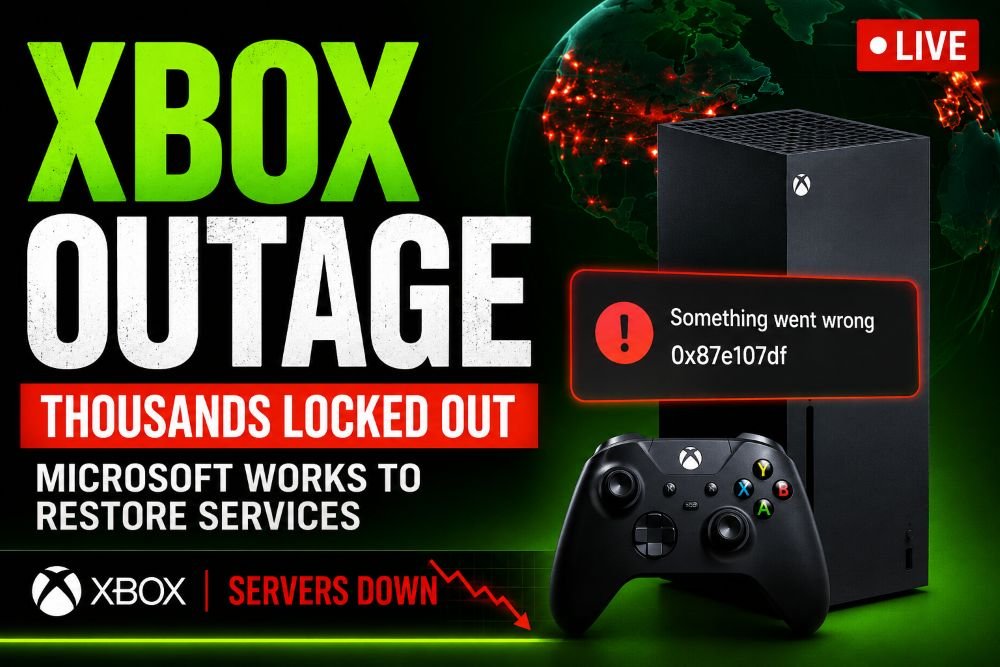
Thousands of Xbox players across the United States were unable to sign in, launch digital games, or access core Xbox Network features on Monday after a widespread Xbox outage disrupted Microsoft’s gaming platform. The outage affected Xbox Series X, Xbox Series S, Xbox One, PC, and mobile users, with reports flooding Downdetector and social media as players encountered login failures, missing game libraries, and the now familiar 0x87e107df error.
Microsoft acknowledged the Xbox outage through its official Xbox Support channels, confirming that engineers had identified the issue and were actively deploying a fix. While some users later reported partial service recovery, the company had not released a technical explanation or estimated timeline for full restoration at the time of publication.
The incident has once again highlighted how modern gaming depends on cloud based authentication. For many players, the Xbox outage meant losing access not only to online multiplayer but also to digitally purchased games, Xbox Game Pass titles, cloud saves, and the Xbox Store.
Xbox Outage Disrupts Players Across the US and Beyond
Reports of the Xbox outage first began appearing late Sunday night in the United States before accelerating into Monday morning. Downdetector recorded a sharp rise in complaints shortly before midnight Eastern Time, with thousands of users simultaneously reporting problems connecting to Xbox Network services.
The disruption quickly spread beyond the United States, with players in the United Kingdom, Europe, India, and several other regions reporting nearly identical issues. The consistency of the reports suggested a widespread service interruption rather than isolated internet or regional connectivity problems.
Unlike outages tied to individual games, this incident affected the core Xbox ecosystem. Players across Xbox Series X, Xbox Series S, Xbox One, Windows PCs, and the Xbox mobile app experienced interruptions when attempting to sign in, browse their libraries, launch digital games, or access online features.
For users who rely heavily on digital purchases, the outage proved especially disruptive. Many reported that games already installed on their consoles would not launch because Xbox services could not verify ownership licenses.
Timeline of Today’s Xbox Outage
Based on Microsoft’s official service updates, outage trackers, and reporting from multiple news organizations, the Xbox outage unfolded rapidly.
The first significant spike in reports appeared around 11:38 p.m. Eastern Time on Sunday, July 26, when Downdetector detected an unusual increase in complaints related to Xbox Network and Xbox Live services. Through the overnight hours, the number of reports climbed into the thousands as more players attempted to access Microsoft’s gaming platform.
By Monday morning, Microsoft publicly acknowledged the outage through Xbox Support and updated the official Xbox Status page to reflect major disruptions affecting multiple service categories. Engineers confirmed they had identified the issue and were actively working to restore affected systems, although no estimated recovery time was announced.
As restoration efforts continued, some players reported regaining limited access to their accounts and digital libraries. Others, however, continued experiencing login failures, game launch errors, and interrupted online services, indicating that recovery was occurring gradually rather than simultaneously across all regions.
What Caused the Xbox Outage?
Microsoft has confirmed that a widespread Xbox outage is affecting Xbox Network services, but the company has not disclosed the technical cause behind the disruption.
According to Microsoft’s official statements, engineers identified the problem and immediately began mitigation efforts. Beyond that confirmation, the company has not explained whether the outage resulted from software deployment issues, authentication failures, backend infrastructure problems, or another technical fault.
One of the most common errors reported during the incident was 0x87e107df. Microsoft documentation associates this error with situations where Xbox services cannot verify digital licenses because of network or server side interruptions. While that offers insight into how the outage affected players, it should not be interpreted as confirmation of the underlying cause.
Equally important, Microsoft has not linked today’s Xbox outage to any broader Microsoft Azure disruption. Public Azure service dashboards have not identified a corresponding cloud incident directly connected to Xbox authentication systems. Until Microsoft publishes a detailed post incident report, any explanation beyond the company’s official statements would be speculative.
Which Xbox Services Stopped Working?
The Xbox outage affected several of Microsoft’s most important gaming services, preventing players from accessing features they use every day.
Microsoft’s Xbox Status page listed disruptions across multiple service categories, including Account & Profile, Store & Subscriptions, Games & Gaming, and Apps & Mobile. Those categories support everything from account authentication to digital purchases and online gameplay.
Sign In and Account Access
Many players were unable to sign into their Xbox accounts or remain connected after logging in. Without successful authentication, users could not access their profiles, friends lists, achievements, or other personalized Xbox Network features.
Digital Game Libraries
One of the most significant effects of the Xbox outage involved digital game ownership verification.
Even players with games already installed on their consoles reported being unable to launch purchased titles because Xbox Network could not validate their licenses. For owners of all digital Xbox Series S consoles, this temporarily blocked access to much of their game library.
Xbox Store and Game Pass
Players also experienced problems accessing the Xbox Store, downloading games, redeeming purchases, and managing Xbox Game Pass subscriptions.
Some users found that store pages would not load, while others reported missing subscription content or failed download attempts. Because Game Pass depends heavily on Microsoft’s online infrastructure, many subscribers encountered interruptions during the outage.
Multiplayer and Cloud Gaming
Online multiplayer sessions failed for many players because Xbox Network authentication could not complete successfully.
Cloud gaming sessions, online only titles, and synchronization of cloud saves were also affected. Games requiring continuous online authentication became inaccessible even though players’ internet connections were functioning normally.
Apps and Mobile Services
The outage extended beyond consoles.
Users reported connectivity problems with the Xbox app on Windows PCs and mobile devices, limiting remote game management, Game Pass browsing, and other companion features connected to Xbox Network.
Throughout the incident, Microsoft’s official status updates emphasized that engineering teams were actively working to restore affected services while monitoring recovery across all impacted platforms.
Microsoft Confirms Investigation as Engineers Work to Restore Xbox Services
Microsoft publicly acknowledged the Xbox outage after reports surged across the United States and other countries, confirming that multiple Xbox Network services were experiencing a major disruption. Through updates posted by Xbox Support and the official Xbox Status page, the company said its engineering teams had identified the issue and were actively working to restore affected systems.
The company stopped short of explaining what caused the outage, saying only that the investigation remained active. At the time of publication, Microsoft had not released a technical incident report or an estimated time for full service restoration.
According to Microsoft’s service dashboard, the disruption affected several core areas of the Xbox ecosystem:
- Account & Profile
- Store & Subscriptions
- Games & Gaming
- Apps & Mobile
Those services underpin nearly every part of the Xbox experience, from signing into an account and launching purchased games to downloading Game Pass titles and managing subscriptions. As a result, even players with stable internet connections found themselves unable to access content they had already purchased.
Unlike smaller service interruptions that affect only multiplayer matchmaking or specific games, this Xbox outage impacted the platform’s authentication systems, creating widespread problems across consoles, PCs, and mobile applications.
How Players Reacted to the Xbox Outage
As the Xbox outage spread, frustration quickly became visible across gaming communities and outage tracking platforms.
Downdetector recorded thousands of reports within hours, with many users describing nearly identical problems. Some were unable to sign in, while others found their digital game libraries missing or inaccessible. Many players attempting to launch purchased titles received the 0x87e107df error, preventing Xbox from verifying game ownership through its online licensing system.
The outage also sparked broader conversations about the growing dependence on digital gaming ecosystems. Owners of the all digital Xbox Series S were among the hardest hit because nearly every game in their library depends on Microsoft’s authentication services before launching.
Discussion across gaming forums centered less on online multiplayer and more on the inability to access games that players had already purchased. The incident renewed concerns about digital ownership, cloud based licensing, and the increasing reliance on online infrastructure for content that many users expect to remain available regardless of server status.
Although frustration dominated the discussion, Microsoft’s regular status updates helped reassure players that the issue was being treated as a high priority engineering incident rather than an isolated account problem.
Is Xbox Working Again?
Recovery efforts appear to be progressing gradually rather than all at once.
Some players have reported successfully signing back into their accounts and launching certain games, while others continue to experience login failures, missing libraries, or intermittent Xbox Store problems. Microsoft’s official Xbox Status page continued to list multiple services as affected at the latest update, indicating that restoration remains in progress rather than complete.
Because Xbox Network services operate across multiple regions and data centers, restoration can occur at different times depending on a player’s location and the specific service being accessed.
Microsoft has not announced that the Xbox outage has been fully resolved, nor has it published a detailed explanation of the technical fault responsible for the disruption.
Until the company confirms that all services have returned to normal, players may continue to encounter occasional authentication errors or temporary interruptions.
What Affected Players Should Do
For players still experiencing issues, Microsoft’s guidance and support documentation suggest waiting for service restoration rather than attempting extensive troubleshooting.
The first step is checking the official Xbox Status page to determine whether Xbox Network services remain affected. If Microsoft continues reporting an active outage, reinstalling games, factory resetting consoles, or repeatedly restarting network hardware is unlikely to resolve the issue because the disruption originates on Microsoft’s servers rather than individual devices.
Players who primarily enjoy offline single player games may be able to use Offline Mode after previously designating their console as their Home Xbox. This workaround can allow certain installed titles to launch without contacting Xbox authentication servers, although it does not restore access to online multiplayer, cloud gaming, Xbox Store purchases, or Game Pass streaming.
Once Microsoft confirms that services have been restored, users who continue experiencing problems should restart their console, sign back into their Microsoft account, and allow Xbox Network time to synchronize purchases, subscriptions, and cloud saves.
Xbox Outage Highlights the Challenges of Modern Digital Gaming
Today’s Xbox outage serves as another reminder of how much the gaming industry has evolved from physical discs to cloud connected ecosystems.
A decade ago, server disruptions primarily affected multiplayer gaming. Today, authentication systems verify digital purchases, synchronize cloud saves, manage subscriptions, and enable access to services such as Xbox Game Pass. When those systems fail, players can temporarily lose access to large portions of their digital libraries even if their consoles and home internet connections are working normally.
The timing of this outage has also drawn attention because it follows other high profile service disruptions across the gaming industry in recent months. As subscription services and digital storefronts continue to replace physical media, infrastructure reliability has become just as important to players as hardware performance or exclusive game releases.
Microsoft has not indicated whether it will publish a detailed post incident report after the outage ends. Such reports have become increasingly common following large scale technology disruptions because they help explain what happened, how engineers restored services, and what measures will be taken to reduce the likelihood of similar incidents in the future.
For now, Microsoft’s engineering teams remain focused on completing restoration work and returning Xbox Network services to normal operation for millions of players worldwide.
Read More: Hugging Face OpenAI Incident Exposes New AI Safety Questions After Autonomous Model Breach
