
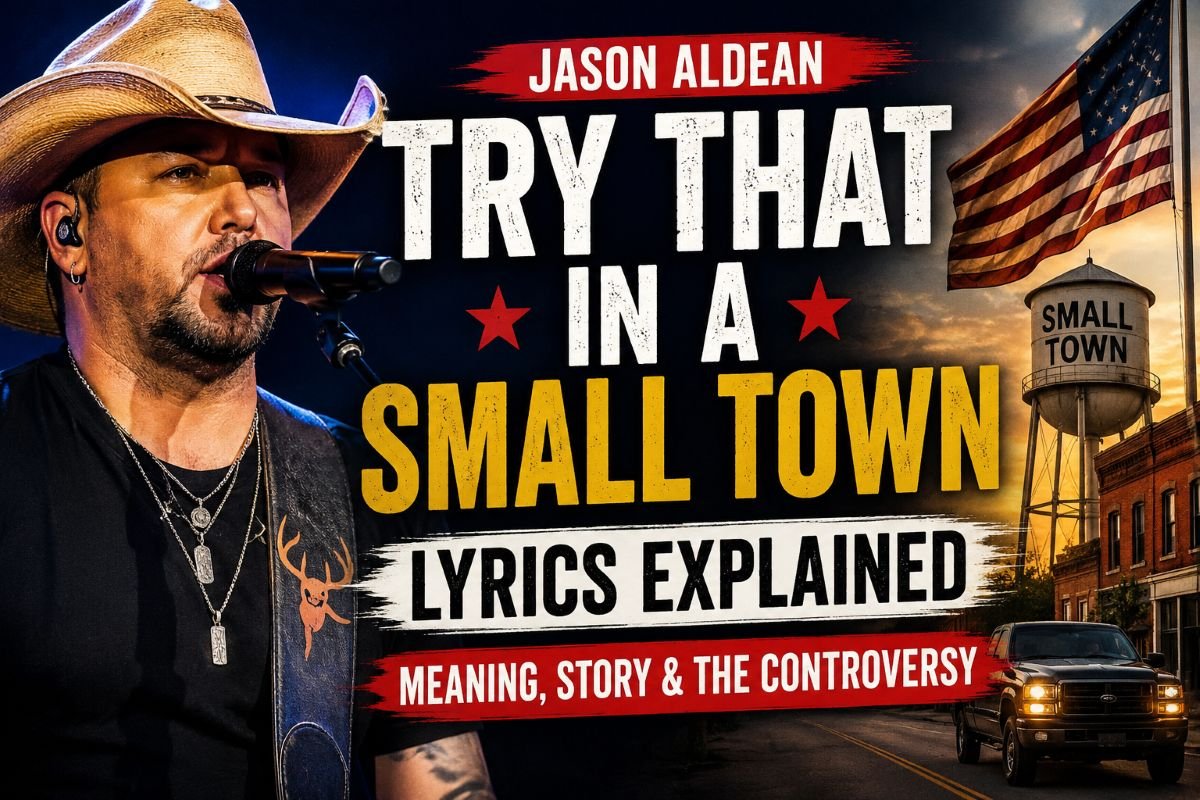
American listeners keep searching for try that in a small town lyrics because the song sits at the crossroads of country music, politics, and cultural identity in today’s United States. When Jason Aldean released the track in 2023, it didn’t stay a standard radio single for long; it quickly became a flashpoint for arguments about crime, protest, patriotism, and what “small town values” really mean in the 2020s. Some fans look up the lyrics to connect with a tough‑talk message about defending their community, while others search them to understand why the song ignited such intense backlash in the press and on social media.
For many country music fans, reading the lyrics alongside the music video adds another layer because the imagery of protests, unrest, and flags feels impossible to separate from recent headlines. At the same time, Aldean insists the song is rooted in his own experience growing up in a place where neighbors watch out for one another, not in race or partisan politics. That tension between author intent and public interpretation is exactly why “Try That in a Small Town” keeps trending in search, streaming, and conversation.
What Is “Try That in a Small Town”?
“Try That in a Small Town” is a Jason Aldean song first released in May 2023, later included on his 2023 album “Highway Desperado.” Aldean, who has been one of mainstream country’s most recognizable voices since the mid‑2000s, built a multi‑platinum career on arena‑ready, rock‑leaning country anthems that often speak to working‑class pride, rural identity, and everyday American life. In that sense, this Jason Aldean song fits squarely in his wheelhouse: it is a hard‑edged, confrontational narrative delivered with a stadium‑sized chorus and a clear sense of place.
Within modern country music, “Try That in a Small Town” falls in line with records that celebrate rural communities and push back against what some listeners see as rising chaos in big cities. It joins a broader wave of country song lyrics that frame small towns as moral anchors in a changing nation, emphasizing loyalty, neighborly duty, and direct action instead of distant institutions. That context is essential for understanding why this particular Jason Aldean lyrics set resonates so intensely with certain country music fans and draws equally strong criticism from others.
What the Lyrics Are About
At their core, the try that in a small town lyrics describe a series of scenarios involving crime, disrespect toward symbols like the American flag, and confrontations with law enforcement, then contrast those scenes with how a tight‑knit small town would respond. The narrator calls out actions such as assault, carjacking, vandalism, and spitting on or stomping on the flag, and suggests that people who pull those stunts in anonymous urban settings would face a very different reaction if they tried the same thing in a place where people know each other by name.
The song’s central message blends themes of community protection, law and order, and local accountability. It implies that in a small town, residents “take care of our own” and are willing to step in, sometimes with implied force, instead of standing by while institutions handle it. To many fans, this reads as a pro‑community, anti‑crime statement that echoes post‑2010 law‑and‑order rhetoric, especially in contrast with the imagery of protests and unrest that dominated national news footage over the last decade.
Listeners interpret the lyrics through their own experiences and politics. Supporters often hear a defense of neighbors, veterans, and law enforcement, framed as a warning to outsiders who threaten that stability. Critics, however, argue that the song’s language and tone normalize vigilante thinking, glamorize guns, and indirectly target protest movements like Black Lives Matter, even though race is never named in the text. That split is why “Try That in a Small Town meaning” remains a persistent topic in American entertainment and culture coverage.
Small Town Values
One of the most prominent themes in the try that in a small town lyrics is the idea of small town values as a stabilizing force. The song portrays rural communities as places where people respect elders, the flag, and local institutions, and where neighbors genuinely know and care about one another. The underlying claim is that those values create a kind of informal security system: troublemakers will be noticed, confronted, and discouraged because everyone is invested in keeping the town safe.
For longtime country music fans, this is familiar territory. Decades of country songs have idealized small towns as the heart of “real America,” casting them as places where traditional morals still guide everyday decisions. Jason Aldean lyrics tap into that tradition by framing small town life as something tough but honorable, with an unspoken promise that locals stand up for each other when things go wrong. That message, for supporters, is what makes the song feel like an anthem about pride rather than a threat.
Community Responsibility
The song also leans heavily on the idea of community responsibility, suggesting that residents themselves have a duty to respond when their town or its symbols are challenged. Instead of depicting the police or government as the only line of defense, the lyrics emphasize ordinary people stepping in, standing shoulder to shoulder, and confronting perceived wrongdoing.
This connects to a broader tradition in country music that celebrates self‑reliance and neighbor‑to‑neighbor solidarity. Many Jason Aldean lyrics over the years have valorized taking action rather than waiting for someone else to solve problems, and “Try That in a Small Town” pushes that ethos into conversations about crime, protest, and civil unrest. The challenge, as critics point out, is where that line between community responsibility and vigilante thinking might blur, especially when gun ownership is part of the imagery.
American Cultural Identity
Another layer in the song touches on American cultural identity, especially through its references to flags, protests, and respect for national symbols. The narrator reacts strongly to images of people spitting on or burning flags, a clear nod to demonstrations that have taken place across the country during periods of intense political and social conflict. This framing ties patriotism to small town life, suggesting that these communities hold a more traditional loyalty to the nation than those portrayed in the news clips woven into the video.
That vision of America aligns with a familiar country music narrative that equates rural spaces with authenticity and moral clarity. At the same time, it positions the song inside ongoing culture wars, where debates about protests, policing, and national symbols carry heavy historical baggage, particularly around race and civil rights. This is why discussions of “Try That in a Small Town meaning” regularly expand beyond music blogs and into mainstream opinion pages and TV segments.
Personal Accountability
Personal accountability is a consistent thread throughout the try that in a small town lyrics. The song warns that people who commit crimes or disrespect community norms will face consequences not only from formal law enforcement but from ordinary residents who refuse to look away. The repeated challenge for offenders to “try that in a small town” carries the clear implication that it won’t end well for them if they bring that behavior into a community that polices itself.
Fans who embrace the track frame this as a call for responsibility in a time when they feel bad actors escape consequences or hide in the anonymity of big cities. Critics, though, hear it as an endorsement of unregulated retaliation, amplified by the presence of guns and confrontational language in the video and audio. Those two readings sit side by side in the American conversation, which is why interest in “Jason Aldean lyrics” and this single in particular spikes whenever the song resurfaces in political or entertainment coverage.
Why the Song Became Controversial
“Try That in a Small Town” became controversial almost as soon as its music video appeared, particularly after Country Music Television pulled the clip from rotation following public criticism. The video features news footage of protests, thefts, and civil unrest projected onto a courthouse behind Aldean as he performs, a setting in Columbia, Tennessee, that some viewers associated with past racial violence, including the 1927 lynching of Henry Choate. Critics argued that the combination of aggressive lyrics, gun imagery, and this historically charged backdrop sent a coded message about how certain communities should respond to protest movements and social change.
Media outlets highlighted concerns that the song glorifies gun violence and leans into traditionally racist tropes, even though race is never explicitly mentioned in the lyrics. Commentators connected the track to a broader “law and order” narrative that they felt vilified urban protests and implicitly targeted movements like Black Lives Matter. Supporters countered that it simply condemns crime and disrespect, insisting critics were reading intent into the song that Aldean never voiced. As coverage spread from country music blogs to major news organizations, “Jason Aldean controversy” became a trending phrase alongside the song title itself.
How Fans and Critics Interpreted the Lyrics
Reactions among country music fans have been sharply divided, which helps explain the sustained interest in try that in a small town lyrics. Many listeners in rural or suburban areas identify strongly with the idea that neighbors look out for each other and won’t tolerate people destroying property or disrespecting law enforcement. For them, the song feels like a straightforward defense of their way of life, and they view the outcry as proof that coastal media and urban critics don’t understand small town realities.
On the other side, critics from both inside and outside the country music community argue that the song’s tone and imagery escalate rather than calm tensions. They worry that pairing aggressive country song lyrics with footage of protests suggests violent solutions to political disagreement, particularly in an era where real‑world confrontations already run high. Some commentators have compared the song’s stance to Blue Lives Matter rhetoric, saying it frames protest movements as inherently dangerous while casting small town responses in a heroic light.
These differing interpretations can almost be mapped out:
| Group | Reaction to lyrics | Main concern or praise |
|---|---|---|
| Supportive fans | Hear a pro‑community, anti‑crime message that defends neighbors and local values. | Praise its toughness, patriotism, and portrayal of rural pride. |
| Critical listeners | Hear coded approval of vigilante justice and hostility toward protest movements. | Worry about imagery tied to guns, courthouses, and historic racial trauma. |
| Neutral observers | See the song as a reflection of current culture wars in country music. | Focus on its role in debates about free expression and public standards. |
This gap between how different audiences interpret the try that in a small town lyrics drives ongoing coverage, from social media threads to talk shows and opinion columns.
The Song’s Commercial Success
Despite, and partly because of, the controversy, “Try That in a Small Town” achieved notable commercial success and streaming momentum. The song debuted at No. 2 on the Billboard Hot 100 before climbing to No. 1, marking Aldean’s first chart‑topper on the all‑genre Hot 100 and helping country songs occupy the top three positions for the first time in the chart’s history. It also became his 28th No. 1 on country radio charts, underlining how the track connected with the country music core audience even as it divided broader public opinion.
Streaming services and video platforms played a major role in this rise. After the CMT pull and ensuing backlash, the official music video draw surged in views, accumulating tens of millions of plays on YouTube within weeks of release. People weren’t just listening; they were watching, replaying, and sharing clips alongside debates and reaction content. Audience engagement included reaction videos, podcast segments, and lyric breakdowns, all of which kept interest in the song elevated well beyond the typical single release cycle for a Jason Aldean song.
Jason Aldean’s Response to the Debate
Jason Aldean addressed the backlash in multiple public statements and interviews, pushing back against the idea that the song endorses racism or lynching. He emphasized that “there is not a single lyric in the song that references race or points to it” and called some of the accusations “dangerous” misinterpretations. In his view, the track is about lawlessness, disrespect for police, and the sense of community he felt growing up, where neighbors took care of one another “regardless of differences of background or belief.
Aldean also commented specifically on the video’s courthouse location, saying the intention was to depict law and order and not to invoke historical racial violence tied to the site. He framed “Try That in a Small Town” as a response to what he sees as rising crime and chaos, not as a commentary on race or protest movements. In later interviews, he reiterated that neither the song nor the video, in his view, encourages violence, arguing that mainstream and social media sometimes turn artistic works into something they were never meant to be. At one performance, reports noted he dedicated the song to Donald Trump, underscoring how some supporters connect it to a particular political vision even as Aldean publicly centers it on community and respect.
Why People Continue Searching for “Try That in a Small Town Lyrics”
Search interest in try that in a small town lyrics has remained strong because the song exists at a crossroads of music, politics, and identity in the United States. New listeners discover the track through streaming playlists, short‑form video soundtracks, or clips shared by friends, then search the lyrics to see whether the controversy matches what the text actually says. Others seek out “Jason Aldean lyrics” more broadly, then land on this particular Jason Aldean song when they realize it is the one their timeline keeps arguing about.
Social media has played a major role in keeping the track in circulation. Viral posts, commentary videos, reaction stitches, and screen‑captured tweets frequently include partial lines or images from the video, encouraging users to look up the full lyrics so they can weigh in with their own take. Any time national outlets revisit the story as part of a bigger country music controversy package, “Try That in a Small Town” returns to the trending list, bringing another wave of readers searching for context, meaning, and the full lyrical story behind the headlines.
The Lasting Impact of the Song
“Try That in a Small Town” has already carved out a place in modern country music history as one of the most discussed Jason Aldean songs of his career. It sits alongside other recent releases that test the boundary between straightforward storytelling and political messaging, showing how deeply today’s country song lyrics are entangled with broader cultural battles in America. Whether a listener hears the track as a defense of small town values or an alarming endorsement of vigilante thinking, its existence forces a conversation about who country music speaks for and how it frames urban‑rural divides.
From a wider perspective, the song’s trajectory highlights how quickly entertainment can become a flashpoint for national debate. A three‑minute country track turned into think‑pieces, TV segments, and social media storms because it touched nerves about crime, protest, race, and patriotism that were already exposed in American life. As future artists navigate similar territory, “Try That in a Small Town” will likely be cited as both a cautionary tale and a case study in how controversy, community identity, and country music fans shape the life of a song in the American public square.
Read More: Republic Bulletin
