
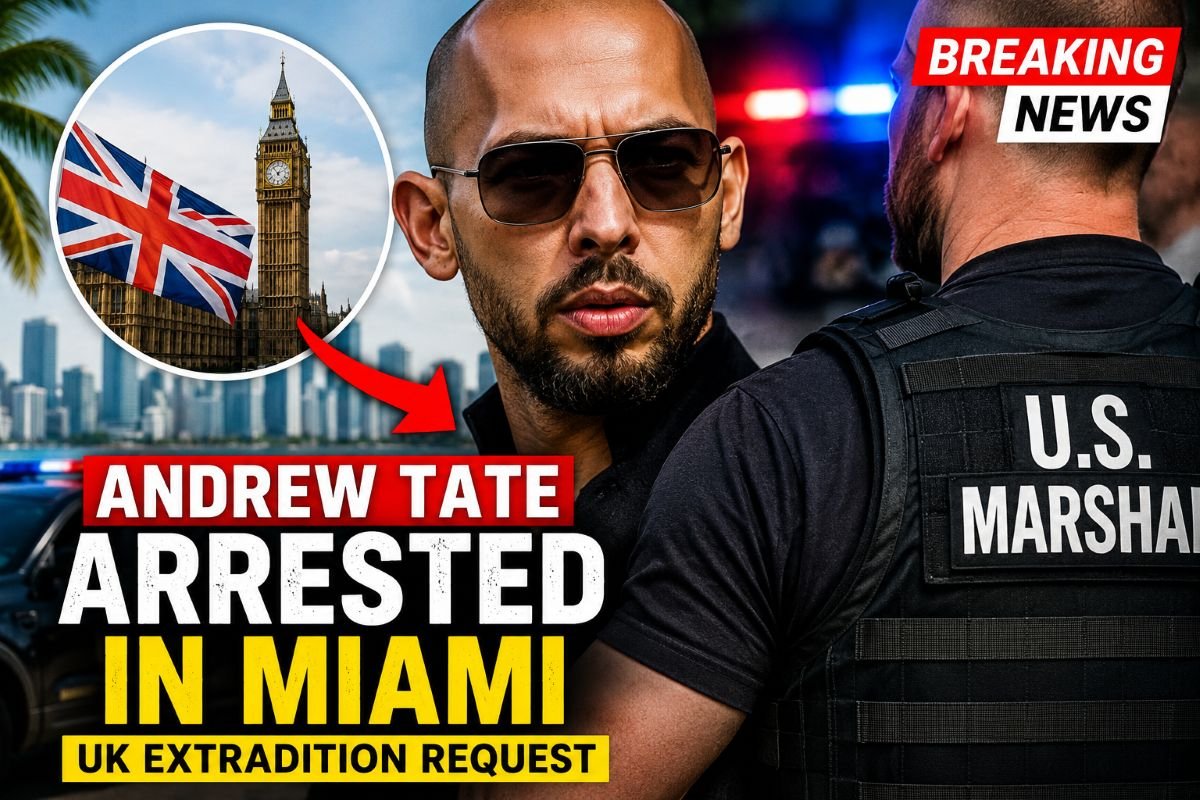
Andrew Tate is back at the center of international headlines after U.S. Marshals arrested him and his brother, Tristan Tate, in Miami following a formal extradition request from the United Kingdom. The arrests came as British prosecutors announced a significantly expanded criminal case that includes new allegations involving multiple complainants. The brothers deny all allegations. The latest development marks the first time Andrew Tate’s long running legal battles have directly entered the American court system, setting the stage for extradition proceedings that could determine whether he is returned to Britain to stand trial.
For American readers, today’s developments are significant because they illustrate how international criminal investigations can quickly reach U.S. soil through extradition agreements between allied countries. While Andrew Tate has spent the past several years fighting legal cases in Romania and facing civil claims in Britain, his arrest in Florida places American courts in the position of deciding the next chapter in one of the world’s most closely watched legal cases involving a social media personality.
The latest Andrew Tate news also represents a major escalation in Britain’s prosecution. The Crown Prosecution Service confirmed that prosecutors had authorized dozens of additional criminal charges following a review of evidence gathered during a lengthy investigation. Officials emphasized that the charges remain allegations that must be proven in court and that both Andrew Tate and Tristan Tate are entitled to a fair trial under British law.
The brothers’ legal team has rejected the allegations, maintaining that Andrew Tate and Tristan Tate are innocent and intend to challenge both the criminal accusations and the extradition request through the courts.
What happened today
Andrew Tate and Tristan Tate were arrested in Miami after the United States received a formal extradition request from the United Kingdom. Federal authorities confirmed the arrests were carried out on behalf of British prosecutors, who are seeking to bring the brothers before a court in England to answer newly expanded criminal charges.
The arrests followed an announcement by Britain’s Crown Prosecution Service that prosecutors had authorized additional counts against both men after reviewing evidence collected during an extensive investigation. The new allegations involve multiple complainants and relate to offenses that prosecutors say occurred over several years.
According to British prosecutors, Andrew Tate faces allegations that include rape, arranging or facilitating trafficking for sexual exploitation, assault, and other serious offenses. Tristan Tate also faces additional criminal allegations connected to the same investigation. Prosecutors stressed that the criminal charges are accusations, not findings of guilt, and reminded the public that ongoing legal proceedings require careful reporting to protect the integrity of future trials.
The arrests do not mean Andrew Tate has been convicted of any offense. Instead, they begin the legal process through which American courts will decide whether the requirements for extradition have been satisfied under the treaty governing cooperation between the United States and the United Kingdom.
Unlike a criminal trial, extradition hearings focus on legal procedure rather than determining innocence or guilt. Judges consider whether the requesting country has met the standards required under international agreements before deciding whether a defendant can be transferred to another jurisdiction.
That distinction is important because Andrew Tate remains involved in separate legal proceedings in Romania, where prosecutors continue investigating allegations that he has consistently denied. The British prosecution operates independently of those Romanian cases, although both involve overlapping periods of the brothers’ public and business activities.
Timeline of today’s developments
News of the arrests spread rapidly after U.S. authorities confirmed that Andrew Tate and Tristan Tate had been taken into custody in Miami under a sealed warrant connected to Britain’s extradition request.
Within hours, Britain’s Crown Prosecution Service publicly disclosed that prosecutors had approved an expanded indictment containing dozens of additional charges involving several complainants. Officials said investigators had gathered sufficient evidence to authorize the new allegations after a lengthy review of the case.
The Crown Prosecution Service also confirmed that formal extradition proceedings had been initiated so the brothers could appear before British courts if American judges approve the request.
Legal representatives for Andrew Tate quickly responded by rejecting the allegations and criticizing the prosecution. Defense attorney Joseph McBride described the case as politically motivated and said both brothers intend to challenge every allegation through the judicial process.
Federal authorities have not released the sealed warrant that formed the basis for the arrests, nor have they disclosed additional investigative details beyond confirming that the arrests were carried out pursuant to Britain’s request.
The case now moves to federal court in Florida, where judges will oversee the initial stages of the extradition process.
Official statements and verified details
The Crown Prosecution Service confirmed that prosecutors had authorized new criminal charges after reviewing evidence gathered during the investigation. Officials stated that the allegations involve multiple complainants and span several years. They also emphasized that criminal proceedings remain active and warned against reporting that could prejudice future court action.
British prosecutors made clear that the filing of charges does not alter the presumption of innocence. They stressed that Andrew Tate and Tristan Tate remain entitled to a fair trial and that the prosecution bears the burden of proving every allegation beyond a reasonable doubt.
The U.S. Marshals Service confirmed that federal authorities arrested both brothers in Miami pursuant to the British extradition request. American officials have not commented publicly on the underlying allegations, focusing instead on the legal procedures governing international extradition.
Attorneys representing Andrew Tate rejected the accusations and argued that the prosecution relies on false allegations. The defense maintains that the brothers have done nothing criminal and intends to challenge both the extradition proceedings and the underlying charges through every available legal avenue.
Officials have not announced how long the extradition proceedings are expected to last. Similar international cases often involve multiple hearings, appeals, and judicial reviews before a final decision is reached.
Legal or investigative background
The latest Andrew Tate developments are part of a legal saga that has unfolded across multiple countries over several years.
Romanian authorities first launched a high profile investigation after accusing Andrew Tate and Tristan Tate of participating in an organized criminal group involved in the alleged exploitation of women. Prosecutors later filed criminal charges that included allegations of human trafficking and rape. The brothers have consistently denied every allegation and have argued that prosecutors mischaracterized consensual relationships.
Romanian courts have issued several rulings during the investigation, including decisions that modified judicial restrictions placed on the brothers while the criminal case remained pending. Although certain travel limitations were eased during 2025 and 2026, prosecutors continued pursuing the investigation, and no final verdict has been reached.
The United Kingdom’s investigation developed independently. British prosecutors conducted their own review before authorizing criminal charges related to alleged offenses committed between 2010 and 2017. This week’s announcement significantly expanded those allegations, adding new complainants and additional criminal counts.
Unlike the Romanian investigation, which remains focused on proceedings within that country’s judicial system, Britain has now formally asked the United States to surrender the brothers through the extradition process. That request transformed an overseas legal dispute into a matter for the American federal court system.
The case has attracted worldwide attention because Andrew Tate remains one of the internet’s most recognizable and controversial personalities. Before his legal troubles dominated headlines, he built an enormous online audience through videos promoting luxury lifestyles, financial success, and highly controversial opinions about gender roles and modern society.
His supporters argue that authorities have unfairly targeted him because of his outspoken public image. Critics counter that prosecutors have gathered sufficient evidence to justify continued criminal proceedings. Those competing narratives have fueled years of intense public debate while courts continue examining the allegations.
Why this matters now
Andrew Tate’s arrest in Miami represents more than another chapter in a years long legal battle. It is the first time American authorities have taken direct action in connection with the United Kingdom’s criminal case, bringing one of the internet’s most controversial figures into the U.S. legal system through the extradition process.
For U.S. readers, the case offers a clear example of how international law enforcement cooperation works when criminal investigations cross national borders. Under longstanding extradition treaties, American authorities can detain individuals wanted by allied countries while federal courts determine whether legal requirements have been met for their transfer overseas. The process is designed to ensure both international cooperation and due process for defendants.
The latest Andrew Tate developments also highlight the growing willingness of prosecutors to pursue complex cases involving alleged crimes that span multiple countries. Digital communications, financial transactions, and international travel have increasingly blurred jurisdictional boundaries, making cooperation between governments a critical part of modern criminal investigations.
Although Andrew Tate’s online presence made him famous, prosecutors have repeatedly emphasized that the allegations are based on alleged criminal conduct rather than his opinions or social media content. The legal proceedings focus on specific accusations presented through evidence gathered during official investigations, not on his public persona or controversial commentary.
The case also underscores the legal distinction between online influence and criminal accountability. Andrew Tate built an audience numbering in the millions through podcasts, interviews, and social media platforms where he discussed business, wealth, masculinity, and relationships. While those views generated both loyal supporters and vocal critics, the current proceedings concern allegations that prosecutors say occurred offline and must ultimately be evaluated through the judicial process.
Legal analysts note that extradition cases involving high profile public figures often receive extraordinary media attention, but judges remain focused on procedural requirements rather than public opinion. Whether a defendant is famous or unknown, courts apply the same legal standards when reviewing extradition requests.
Public reaction and broader context
News of Andrew Tate’s arrest spread rapidly across social media, where his name quickly became one of the day’s most discussed topics. Supporters questioned the timing of the arrests and repeated claims made by the defense that the brothers have been unfairly targeted because of their prominence and controversial public image.
Others argued that the expanded charges announced by British prosecutors demonstrate the seriousness of the investigation and welcomed the opportunity for the allegations to be examined in court. Advocacy groups that support victims of sexual violence emphasized that criminal proceedings should be allowed to unfold through the judicial system while respecting the legal rights of both complainants and defendants.
The sharp divide in public reaction reflects the unusual position Andrew Tate occupies in modern internet culture. Few online personalities have attracted such a large global audience while simultaneously becoming the subject of multiple criminal and civil proceedings across several countries.
His influence has extended well beyond social media platforms. Podcasts, streaming channels, and online communities have frequently debated both his message and the legal controversies surrounding him. Schools, parents, educators, and policymakers have also discussed the impact of his online content on younger audiences, making his legal troubles part of a broader conversation about internet influence and accountability.
At the same time, legal experts caution against allowing public opinion to shape expectations about the outcome of criminal proceedings. Under both American and British law, defendants are presumed innocent unless prosecutors prove guilt beyond a reasonable doubt. That principle remains central regardless of media attention or the popularity of those involved.
The case has also drawn attention because it involves parallel legal proceedings in multiple jurisdictions. While Britain seeks extradition through American courts, Romanian prosecutors continue pursuing their own investigation. Each country applies different legal standards, follows separate procedures, and independently evaluates evidence gathered during its investigation.
That international complexity means the legal process may continue for months before major questions are resolved. Even after initial extradition hearings, appeals and additional court reviews could extend the timeline considerably.
What comes next
The immediate focus now shifts to federal court in Florida, where Andrew Tate and Tristan Tate are expected to make their initial appearances following their arrests. Judges will begin reviewing the British extradition request and determine the next procedural steps under the treaty governing cooperation between the United States and the United Kingdom.
During those hearings, the court will not decide whether the brothers committed the alleged offenses. Instead, judges will examine whether Britain’s request satisfies the legal standards required for extradition. The defense will have the opportunity to challenge both the request itself and aspects of the underlying legal process before any transfer can occur.
If extradition is ultimately approved after all available legal challenges have been exhausted, British authorities would take custody of the brothers so they could face the criminal charges authorized by the Crown Prosecution Service. Prosecutors would then begin presenting evidence in a British courtroom, where witnesses could testify and the defense would have the opportunity to challenge the prosecution’s case.
Meanwhile, Romanian proceedings remain active and continue on a separate legal track. Courts in Romania will independently address the allegations pending there, and future coordination between British and Romanian authorities could become an important procedural issue if both jurisdictions seek to move their cases forward.
The coming weeks are expected to provide greater clarity as federal court filings become public and additional details emerge about Britain’s extradition request. Prosecutors may disclose more information regarding the expanded criminal allegations, while defense attorneys are likely to continue challenging both the factual basis of the accusations and the legal process surrounding the extradition effort.
For now, one fact is clear. Andrew Tate’s legal battles have entered a new phase. What began as investigations centered in Europe has now reached the United States, placing American courts at the center of an international case that continues to attract worldwide attention. The decisions made during the upcoming extradition proceedings could shape the direction of multiple legal cases and determine where Andrew Tate next answers the allegations against him.
Read More: Moussa Cisse Agrees to Knicks Offer Sheet as Mavericks Face 48 Hour Decision
