


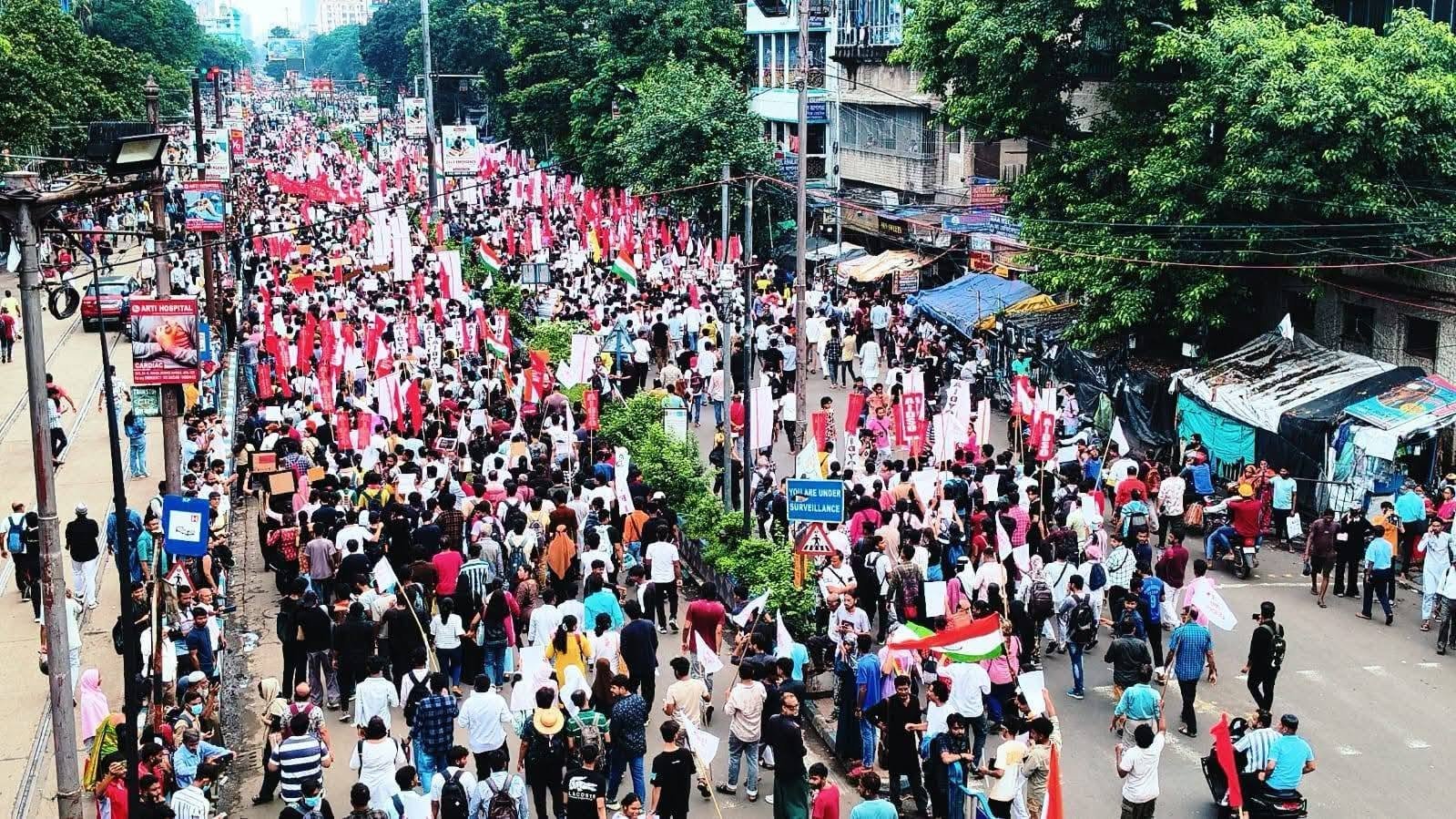
CJP Kolkata Protest: Thousands of students, youth activists and civil society members gathered in central Kolkata on Friday as the city became the latest stop in a nationwide protest movement led by supporters of the Cockroach Janta Party (CJP). The demonstration, which centred on concerns over alleged irregularities in the National Eligibility cum Entrance Test (NEET) and broader demands for reforms in India’s examination system, brought parts of Kolkata’s busy commercial district to a standstill and sparked a tense confrontation with police.
The protest began near Sealdah Railway Station before moving towards Esplanade through S.N. Banerjee Road. Organisers described the march as a peaceful demonstration calling for transparency in public examinations, accountability from the National Testing Agency (NTA), and the resignation of Union Education Minister Dharmendra Pradhan. Participants also expressed solidarity with student protesters in Delhi and social activist Sonam Wangchuk, whose recent hunger strike drew national attention to issues surrounding education and governance.
The Kolkata rally formed part of a broader campaign that has spread across several Indian cities following public anger over alleged examination irregularities. While the movement initially focused on the NEET controversy, it has gradually expanded to include wider concerns about recruitment transparency, youth unemployment and public confidence in government institutions.
According to organisers, the Kolkata protest was intended to highlight what they describe as growing frustration among students who believe repeated controversies surrounding competitive examinations have undermined trust in India’s education system. Protesters carried banners demanding “Justice for Students”, “Save Our Future” and “Transparent Examinations”, while chanting slogans against alleged mismanagement of national entrance tests.
Before the march, CJP representatives reportedly sought permission to organise an independent rally from College Square to Rani Rashmoni Road. However, as that proposal did not proceed, supporters joined an already planned procession led by Left-leaning student organisations travelling from Sealdah to Esplanade. The combined demonstration attracted students from universities across Kolkata, including representatives from various youth and student groups.
As the procession moved through central Kolkata, police maintained a significant security presence. Barricades were erected at several locations, and traffic police introduced diversions to manage congestion along one of the city’s busiest transport corridors. Officers accompanied the procession while attempting to ensure that emergency services and public transport could continue operating despite the growing crowds.
The atmosphere remained largely peaceful during the early stages of the march. Protesters marched with placards, waved flags and addressed supporters through loudspeakers, calling for reforms to examination procedures and stronger safeguards against future paper leaks. Many participants said they had travelled from different districts of West Bengal to join the demonstration, describing it as an opportunity to express concerns shared by students across the country.
Tensions increased after sections of the crowd attempted to stage a sit-in near Esplanade and surrounding intersections. Police asked demonstrators to remain within agreed movement restrictions, but disagreements over the route and the planned sit-in led to a confrontation. As officers attempted to clear key junctions, clashes broke out between some protesters and security personnel.
Reports from the scene indicated that police used crowd-control measures to disperse parts of the gathering after repeated requests to vacate the road were not followed. Protest organisers, however, alleged that excessive force had been used against demonstrators who they insisted were exercising their democratic right to protest peacefully. Authorities maintained that their actions were necessary to restore public order and prevent prolonged disruption in one of Kolkata’s busiest commercial areas.
The confrontation temporarily affected traffic movement across central Kolkata. Buses were diverted, taxi services experienced delays and commuters travelling through Esplanade, Dharmatala and nearby areas faced significant congestion during the afternoon. Although Metro Rail services continued operating, stations near the protest route experienced unusually heavy passenger volumes as travellers adjusted their routes.
The demonstration also attracted considerable political attention. Supporters of the protest argued that students have legitimate concerns regarding examination integrity and deserve transparent investigations into allegations of irregularities. They said the movement represents a wider demand for accountability rather than support for any single political party.
Political reactions reflected the increasingly polarised debate surrounding the issue. Some opposition leaders expressed support for the students’ demands and criticised the handling of examination controversies, while government representatives continued to defend the examination process and pointed to ongoing efforts to strengthen safeguards against malpractice. Civil society groups called for dialogue between authorities and protesters, emphasising that democratic societies must balance the right to peaceful assembly with the need to maintain public order.
The legal context surrounding the protest also became part of the public discussion. Under Article 19 of the Constitution of India, citizens have the right to freedom of speech and peaceful assembly, although these rights are subject to reasonable restrictions in the interests of public order and security. Legal experts noted that police are empowered to regulate the time, place and route of demonstrations, but any use of force should remain proportionate and subject to accountability.
Beyond the immediate confrontation, the Kolkata protest reflects deeper anxieties among India’s youth. Competitive examinations such as NEET play a crucial role in determining educational and professional opportunities for millions of students. Allegations of paper leaks or administrative failures therefore generate widespread concern, particularly among candidates who spend years preparing for these highly competitive tests.
Many protesters said their participation extended beyond the NEET issue alone. They argued that repeated controversies surrounding recruitment examinations and government hiring have created uncertainty for young people seeking careers in the public sector. For them, the protest represented an opportunity to demand systemic reforms aimed at restoring confidence in examination and recruitment processes.
Despite the clashes, organisers indicated that their campaign would continue through peaceful demonstrations and public awareness programmes. They maintained that examination reforms, greater transparency and accountability remain their primary objectives. Police, meanwhile, reiterated that while peaceful protest is a constitutional right, demonstrations must comply with lawful conditions designed to protect public safety and minimise disruption.
The CJP Kolkata Protest has become one of the most significant student-led demonstrations in West Bengal this year, drawing attention not only to examination reforms but also to broader questions about governance, youth aspirations and democratic participation. Whether the movement succeeds in influencing policy remains uncertain, but it has already succeeded in placing the concerns of students at the centre of the national conversation.
As discussions continue between protest organisers, political leaders and government authorities, the events in Kolkata serve as a reminder that issues affecting education often resonate far beyond classrooms. They touch on public trust, equal opportunity and the expectations of a generation that views fairness in examinations as fundamental to its future.
Read More: Hugging Face OpenAI Incident Exposes New AI Safety Questions After Autonomous Model Breach
